What is flame treatment?
Flame treatment is a thermal surface treatment process primarily used on plastic parts with low surface tension, such as ABS, to modify the material’s surface energy. By applying a controlled flame, microscopic contaminants are removed and surface bonds are activated, significantly improving the adhesion of paints, inks, and coatings.
Unlike other treatments, flame treatment is a fast, effective process compatible with automated lines, requiring no chemicals and allowing direct integration into industrial painting processes with a high degree of control and repeatability. ``
Flame treatment booths integrated into paint lines
Coapsys flame treatment booths are designed as closed, safe, and fully controlled systems, integrable into industrial paint lines. They incorporate industrial robots equipped with high-precision burners that apply the treatment uniformly and repeatably to each part.
The booth design ensures control of the thermal process, flame stability, and environmental protection, enabling effective treatment of plastic surfaces without deformation or material damage.
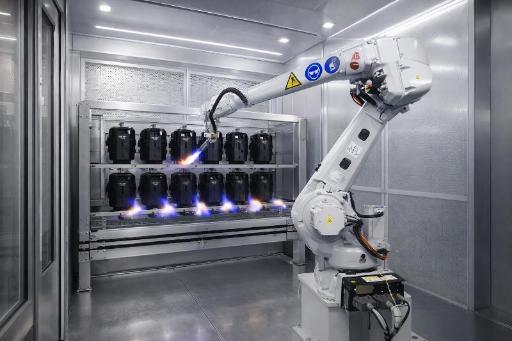
Part entry
Plastic parts enter the booth via a conveyor or rack integrated into the line.
Controlled flame treatment
The industrial robot applies the flame precisely and uniformly across the surface of each part.
Process control
Flame parameters, distance, and exposure time are controlled to ensure surface activation without damaging the material.
Paint line exit
The parts exit treated and ready for the painting or coating process.
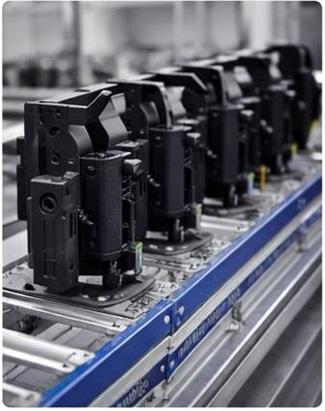
Improves adhesion
Increase in surface energy for improved paint and coating adhesion.
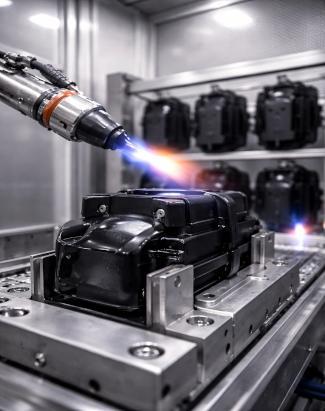
Controlled process
Flame parameters, distance, and time adjusted for a uniform and repeatable treatment.

Chemical-free
Surface treatment without primers, solvents, or chemical agents.
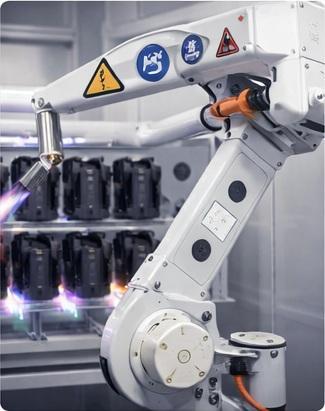
Line integration
Applicable on automated lines without affecting production flow.
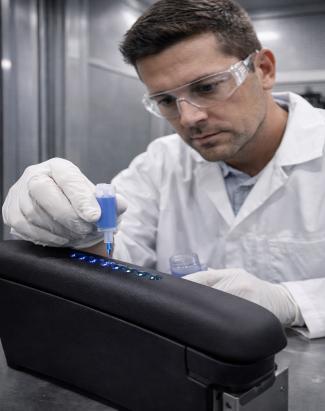
Surface energy validation
The flame treatment process is validated through surface tension measurements, ensuring that parts reach the required activation level before painting. These checks verify treatment effectiveness and guarantee process repeatability.
The integration of in-line quality controls or at defined process points ensures surface preparation in accordance with customer requirements and OEM standards.