Thermal gas treatment solutions for industrial processes.
Industrial painting processes generate emissions of volatile organic compounds (VOCs) that must be treated to reduce their environmental impact and comply with current regulations. The proper treatment of these gases is a key element in the design of sustainable industrial installations.
At Coapsys we design and integrate thermal gas treatment systems, selecting incineration and regenerative thermal oxidation (RTO) technologies adapted to the characteristics of each process, flow rate and concentration of contaminants. These solutions allow effective emission reduction, optimizing energy consumption and ensuring stable and safe operation in continuous production lines.
Thermal incineration
Thermal incineration enables the elimination of VOC through high-temperature oxidation, being suitable for processes with stable concentrations and controlled flow rates. This technology offers effective emission reduction and robust operation in demanding industrial environments.
Regenerative thermal oxidation (RTO)
RTO systems use regenerative chambers to recover the thermal energy from the process, achieving high VOC removal efficiencies with optimized energy consumption. They are especially suitable for large flow rates and continuous applications, ensuring efficiency and operational stability.
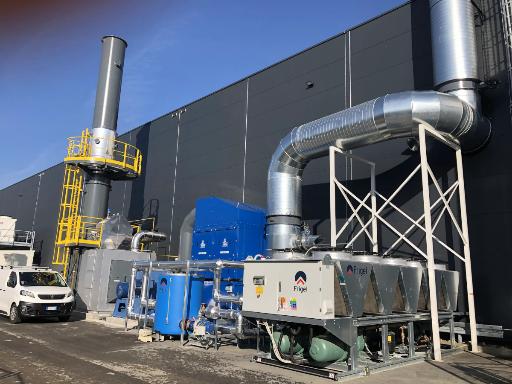
Integration of gas treatment systems in painting lines
Gas treatment systems are integrated as the final part of the industrial painting process, managing emissions from booths, ovens and evaporation zones before their discharge into the atmosphere.
The proper integration with the line’s extraction, ventilation and control systems allows the treatment to be adapted to the actual VOC flow rates and concentrations, optimizing system performance, reducing energy consumption and ensuring continuous and safe operation.
Gas extraction
VOC-laden gases are extracted in booths, ovens and evaporation zones through extraction systems sized according to flow rate and concentration.
Ducting and regulation
The extracted gases are conveyed to the treatment system, regulating flow rate, temperature and pressure for stable equipment operation.
Thermal treatment
VOCs are thermally oxidized through incineration or RTO systems, transforming them into CO₂ and water vapor with high removal efficiency.
Energy recovery
In RTO systems, the generated thermal energy is recovered to preheat the incoming air, reducing the overall energy consumption of the system.
Controlled emission
The treated gases are discharged into the atmosphere in compliance with the emission limits established by current environmental regulations.
Filtration systems in RTO installations
Regenerative thermal oxidation (RTO) systems incorporate specific filtration stages to protect the equipment and ensure stable and safe long-term operation. These stages allow the removal of solid particles, aerosols and residues from the process before entering the thermal system.
The proper selection and sizing of filtration systems prevents fouling in the regenerative heat exchangers, reduces maintenance and ensures constant thermal performance. Depending on the process, pre-filtration at the extraction stage, intermediate filtration in ductwork or specific RTO protection systems can be integrated, adapted to the type of emission and operating conditions.
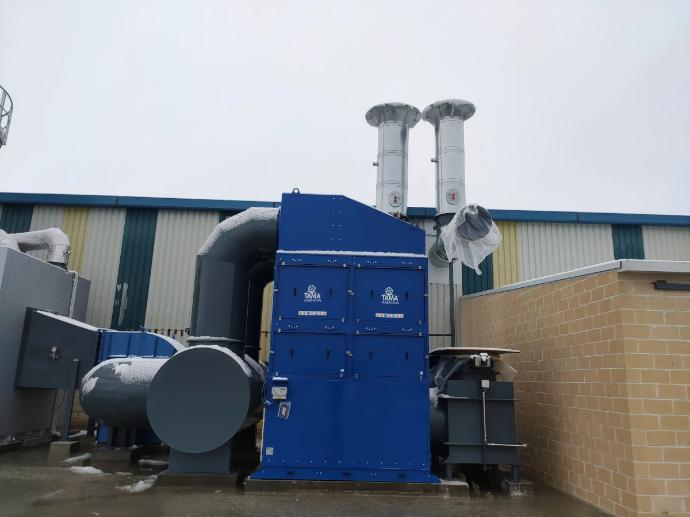
Use of rotor concentrators in fresh air and recirculation systems.
In installations where gas treatment is carried out from fresh air, the flow rates to be treated are usually high and the VOC concentrations low. In these cases, the use of rotor concentrators is common, allowing the contaminants to be adsorbed and concentrated into a reduced flow rate, optimizing the sizing and energy consumption of the subsequent thermal treatment system.
In systems based on air recirculation, VOC concentrations are naturally higher and the flow rates to be treated lower. In this type of configuration, thermal treatment can be carried out directly by incineration or RTO, without the need for rotor concentration, simplifying the installation and reducing system complexity.
The choice between fresh air with rotor concentrator or direct recirculation depends on the characteristics of the process, the flow rates, the contaminant concentrations and the energy and environmental requirements of the installation.
Automated lines
Integration of gas treatment systems in continuous lines with conveyors, robots and centralized control, ensuring stable operation coordinated with the rest of the production process.
Metalworking industry
Thermal treatment of emissions generated in industrial coating processes of metallic components, integrating with existing ventilation and extraction systems.
Plastic components
Sistemas de tratamiento de gases adaptados a procesos de pintado de piezas plásticas, gestionando caudales variables y bajas concentraciones de COV con alta eficiencia energética.
Automotive
Treatment of emissions from paint booths, ovens and evaporation zones in OEM and Tier 1 lines, ensuring VOC reduction and compliance with environmental requirements in high-demand processes.